
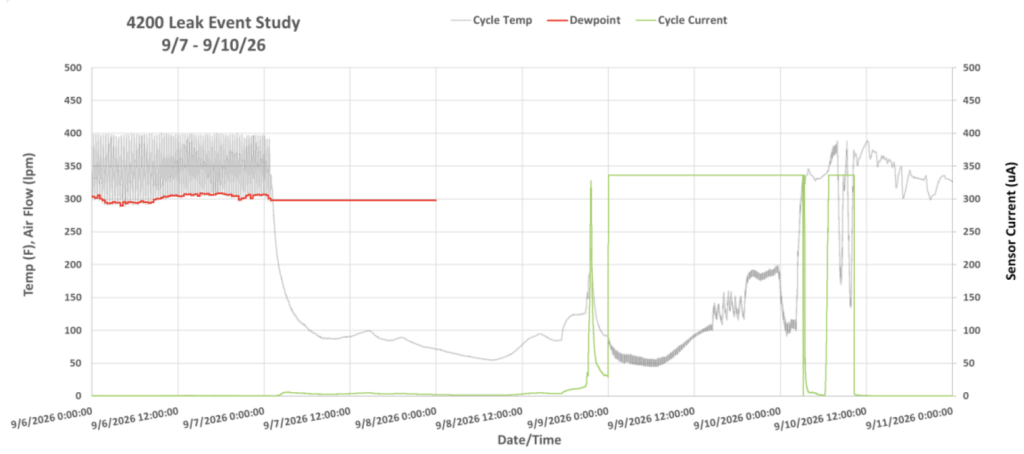
An Ei4200 was installed at a sulfuric acid plant (sulfur burner) in the central United States in October of 2025. The instrument operated continuously and as intended, with only one service visit from Ohio Lumex staff until a tube leak was reported by the plant to the Ohio Lumex Field Service representative on 9/16/2026.
During that initial report, it was stated that the Ei4200 “flat lined” as of 9/7/2026 but that the leak was discovered during the morning shift on 9/10/2026.
At the request of OL technical support, the plant recovered the daily operational data logs from the instrument covering the time period from 9/6 – 9/12/2026. This report covers the findings from that data when compiled with the plant actions during the same time period.
- In summary, the instrument data logs showed that a “high current” event was logged on 9/7/2026 at roughly 1:00 AM. Following that event these actions occurred:
- Whatever compound led to the initial “high current” event stayed resident on the probe sensor surface and resisted vaporization using native heat in the flue gas. This resulted in the probe never reaching “Start Temperature” for the next cycle.
- As a result of this failure to remove the condensate, the system never reported a successive “dewpoint” event. As a result of this, the output stayed constant and appeared to the operators as a loss of communication or a “flat line”
- This condition continued until roughly 5:30 PM on 9/8 when a significant current spike (to 328 uA) began. This spike was NOT due to decreasing cell temperature so it must be attributed to a second, larger, ingress of water into the ductwork.
- This current spike dissipated for several hours, then reappeared at 00:13 AM on 9/9/2026. This is nearly 48 hours after the initial current spike detected by the Ei4200
- The current spike at 0:13 AM on 9/9 persisted at 337 uA (this is the saturation current of the sensor cell) until the unit management discovered the leak and acted, more or less, at 3:00 AM on 9/10 (this is 72 hours after the initial current incident).
- Based on Instrument data, the current spike dissipated at 3:00 AM when, we assume, the plant discontinued water flow into the unit. This lack of water flow persisted until 6:30 AM on 9/10 when water flow was apparently resumed.
- The water flow/current saturation appears to persist for roughly 4 hours and then falls dramatically at 10:30 AM
We are anxious to correlate plant actions with the data reported by the instrument but, as of this writing, it appears that the instrument detected a small water leak just before 1:00 AM but no leak was reported to the plant. The plant reacted in their own methods 72 hours later.
Why the instrument failed to report the leak event, and the subsequent corrective measures taken, is the topic of the paper below.